



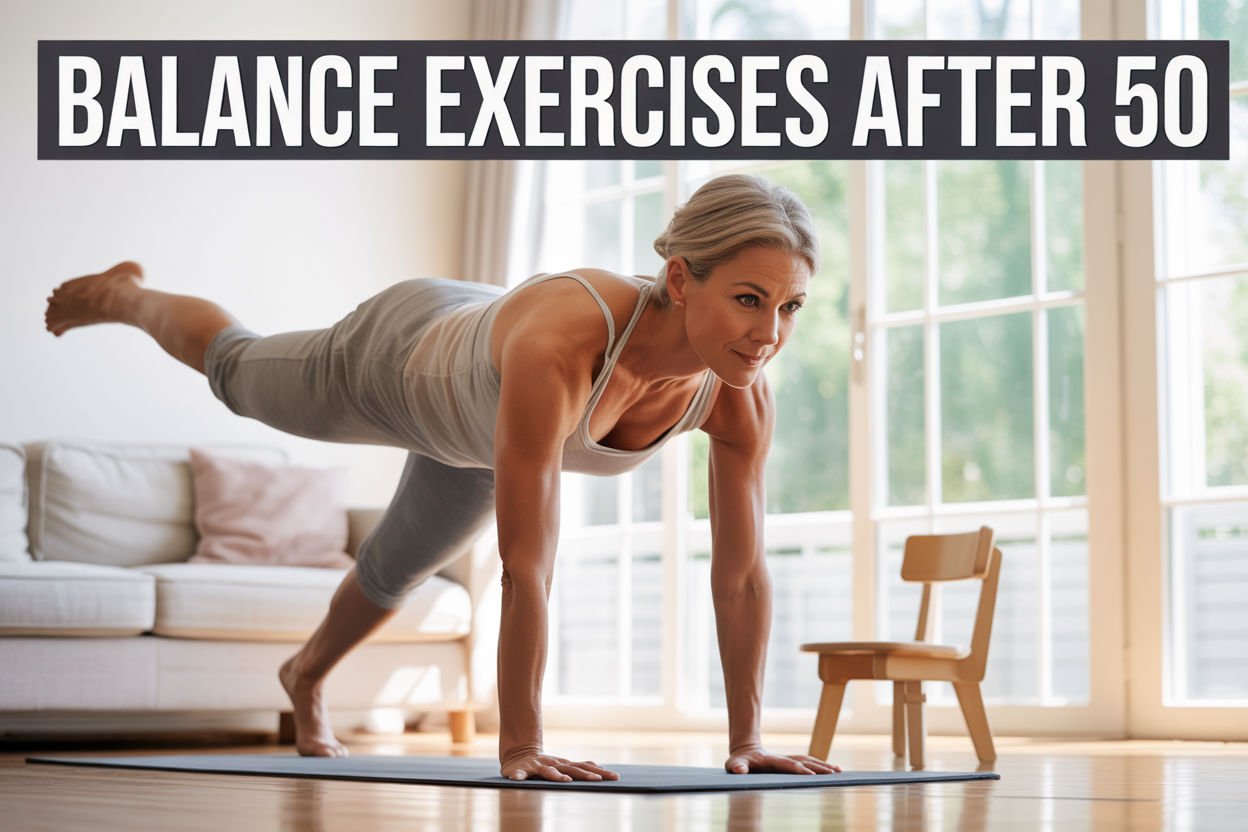
7 Balance Exercises That Prevent Falls After 50
Falls are the leading cause of injury in adults over 50 — and most of them are preventable. If you’ve noticed you feel less steady on your feet, wobble getting out of a chair, or hesitate on uneven ground, your balance system needs attention. The good news? A few targeted moves done consistently can make a real difference.
This guide is for adults 50 and older who want to move through daily life with more confidence and less fear of falling. You don’t need a gym membership or fancy equipment to get started.
Here’s what you’ll find inside:
- Why balance declines after 50 and what’s actually happening in your body
- 7 proven balance exercises for seniors — including the single-leg stand exercise, tai chi for balance and stability, and lower body strength exercises — explained step by step
- What to expect before you start, so you can train safely and build progress at your own pace
Whether you’re just starting out or looking to level up your senior balance training, these exercises meet you where you are. Let’s get into it.
Table of Contents
Why Balance Declines After 50 and Why It Matters
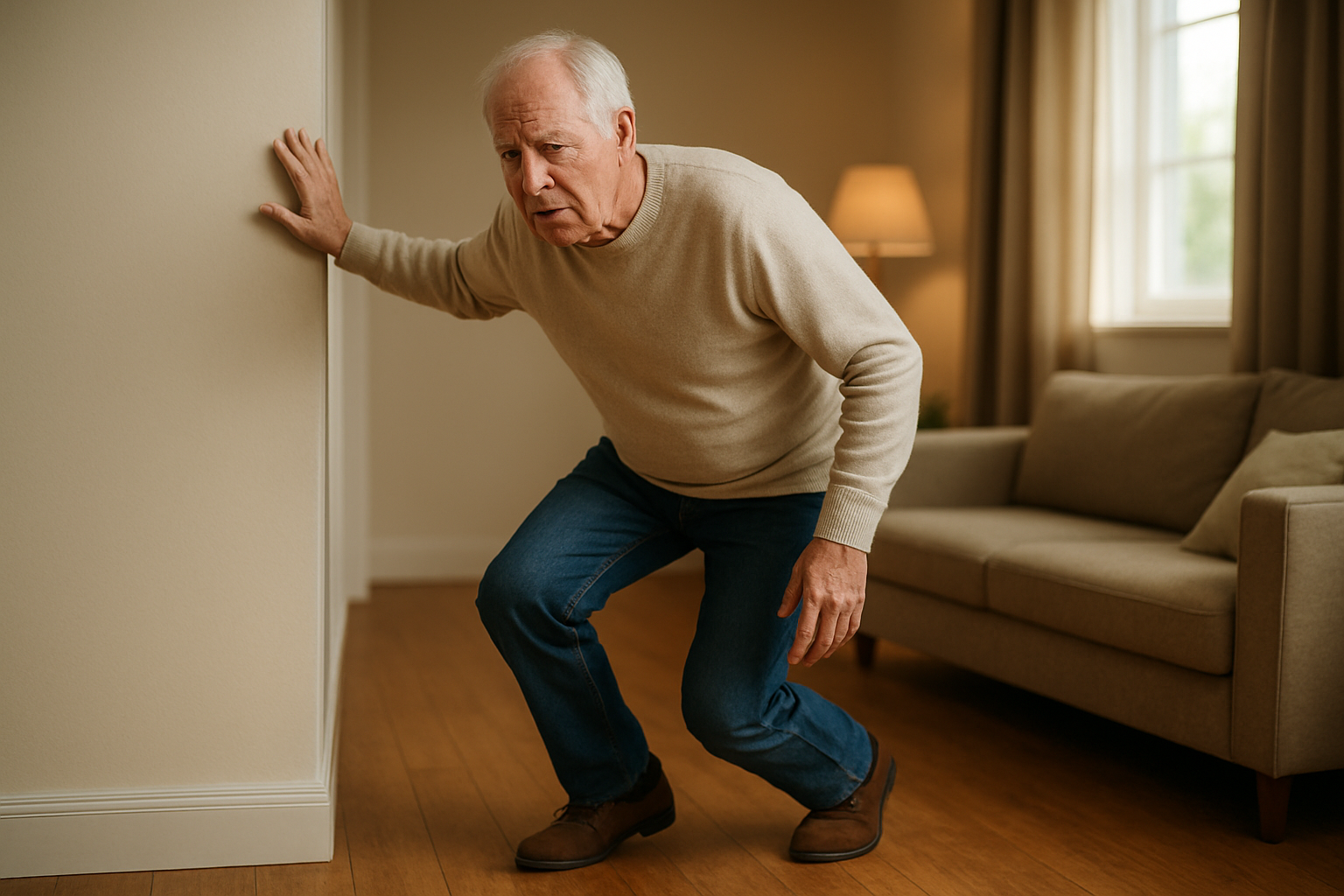
How Aging Affects Your Muscles, Joints, and Inner Ear
After 50, several things happen at once that chip away at your balance:
- Muscle mass drops — You lose roughly 3–5% per decade, weakening the stabilizing muscles in your legs and core
- Joint sensitivity fades — Proprioception (your body’s sense of where it is in space) becomes less sharp
- Inner ear changes — The vestibular system, which tracks head movement and orientation, becomes less responsive
- Reaction time slows — Your brain takes a split second longer to correct a stumble
The Real Cost of Falls for Adults Over 50
Falls aren’t just embarrassing — they’re dangerous. Consider:
| Impact | Reality |
|---|---|
| Hip fractures | Leading cause of loss of independence in seniors |
| Fear of falling | Causes people to move less, accelerating decline |
| Medical costs | Falls cost the U.S. healthcare system over $50 billion annually |
Why Balance Training Is the Most Effective Prevention Strategy
Medication won’t fix weak glutes. Surgery won’t sharpen your proprioception. But consistent balance exercises for seniors directly target every physical factor behind falls — muscle strength, coordination, and neuromuscular response — making it the single most practical tool for fall prevention exercises over 50.
What to Expect Before You Start These Exercises
How to Assess Your Current Balance Level Safely
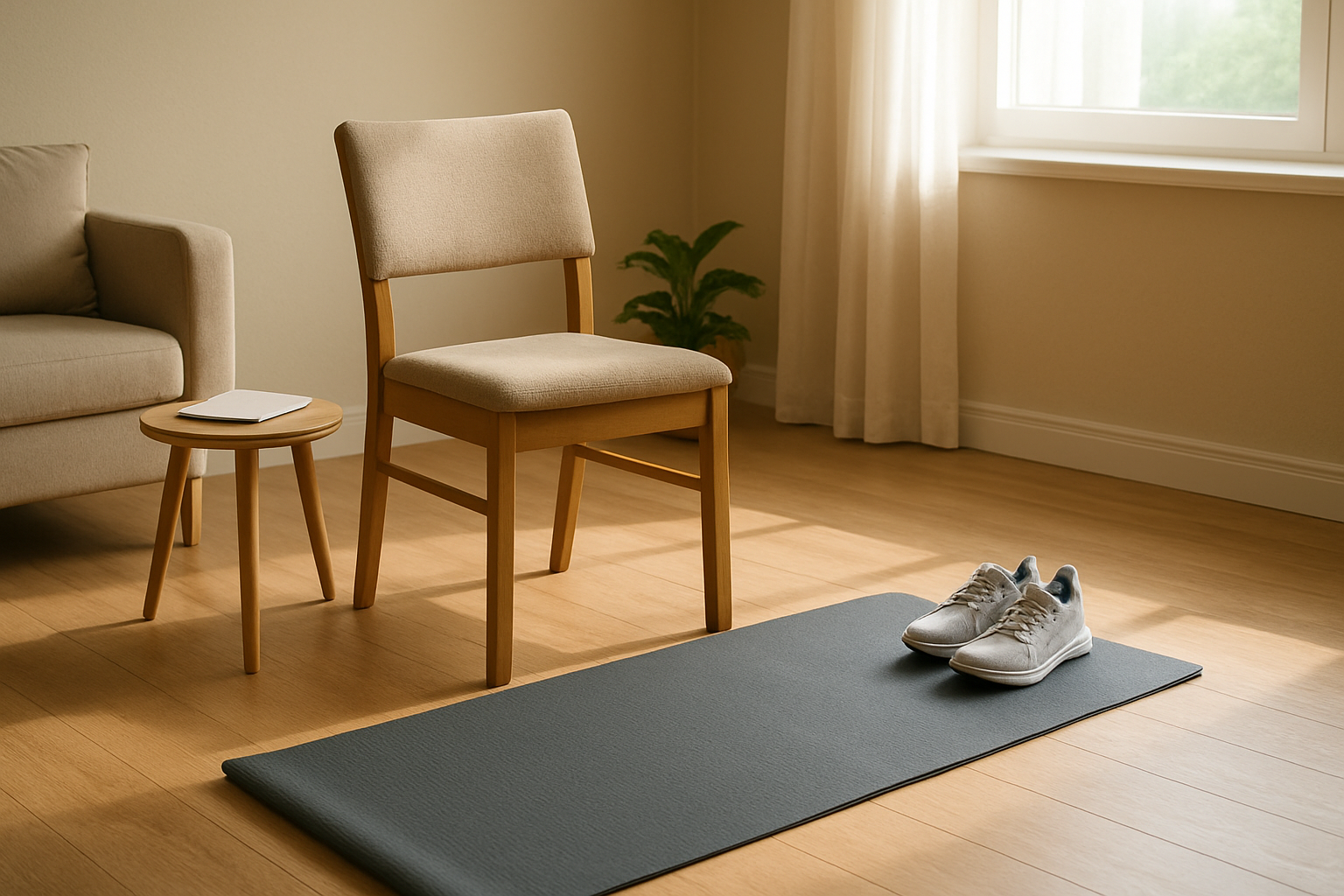
Stand near a wall or sturdy chair and try balancing on one leg for 30 seconds. If you wobble within 10 seconds, you’re starting at a beginner level. That’s completely fine — it just tells you where to begin.
Simple Safety Tips to Prevent Injury During Practice
- Always keep a chair, wall, or countertop within arm’s reach
- Wear non-slip shoes or go barefoot on carpet
- Clear the floor of rugs, cords, or clutter before starting
- Never push through sharp pain — discomfort is normal, pain is a signal to stop
How Often to Train for Noticeable Results
Consistency beats intensity every time. For senior balance training and fall prevention exercises over 50, aim for:
| Frequency | Expected Outcome |
|---|---|
| 3x per week | Noticeable improvement within 4–6 weeks |
| 5x per week | Faster gains in stability and coordination |
| Daily | Best long-term results for improving balance after 50 |
Even 10–15 minutes per session makes a real difference.
When to Consult Your Doctor Before Beginning
Talk to your doctor first if you:
- Have a recent injury, surgery, or joint replacement
- Experience frequent dizziness or vertigo
- Take medications that affect coordination or blood pressure
- Have osteoporosis or a neurological condition
Single-Leg Stand to Build Stability Fast
Step-by-Step Instructions for Beginners
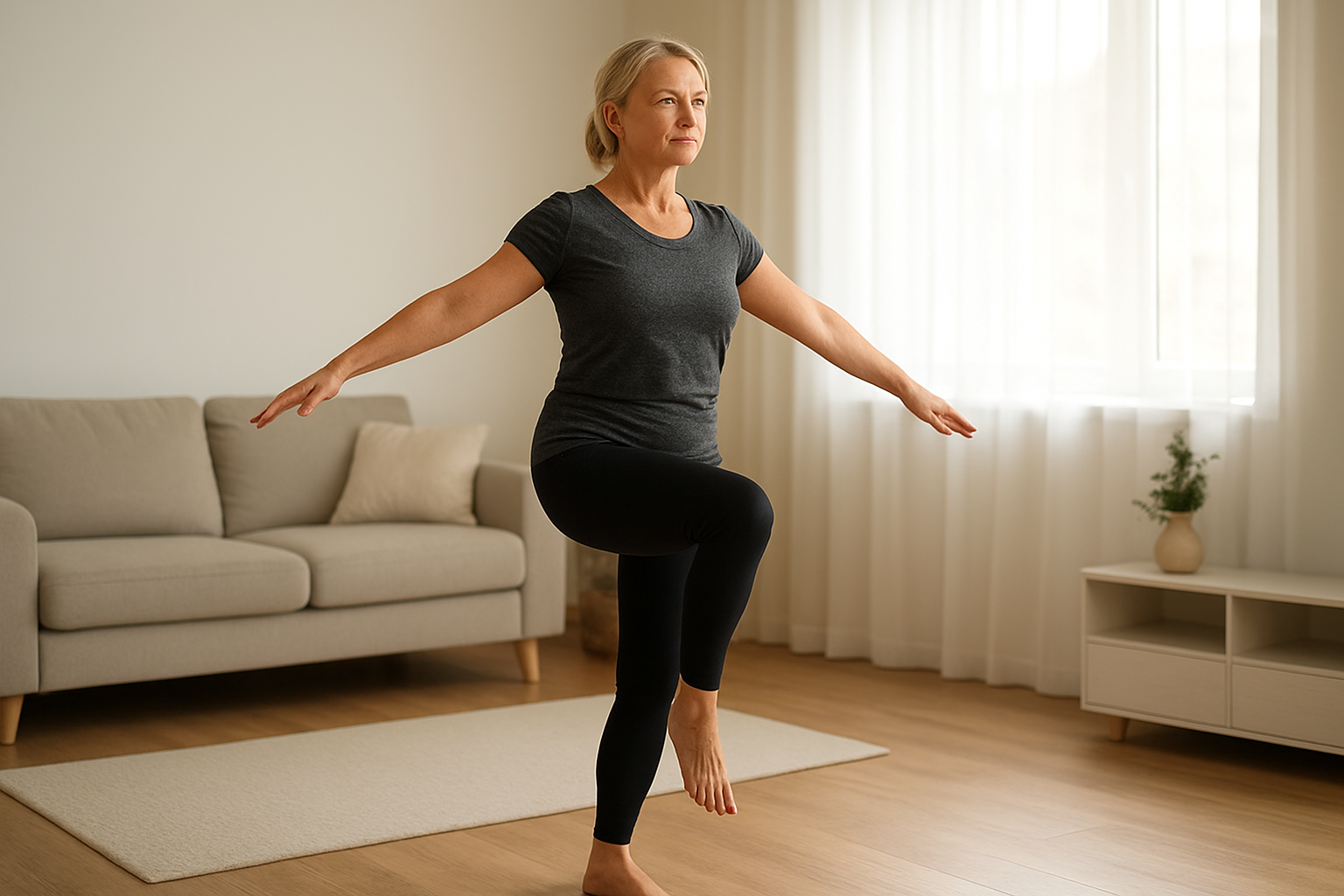
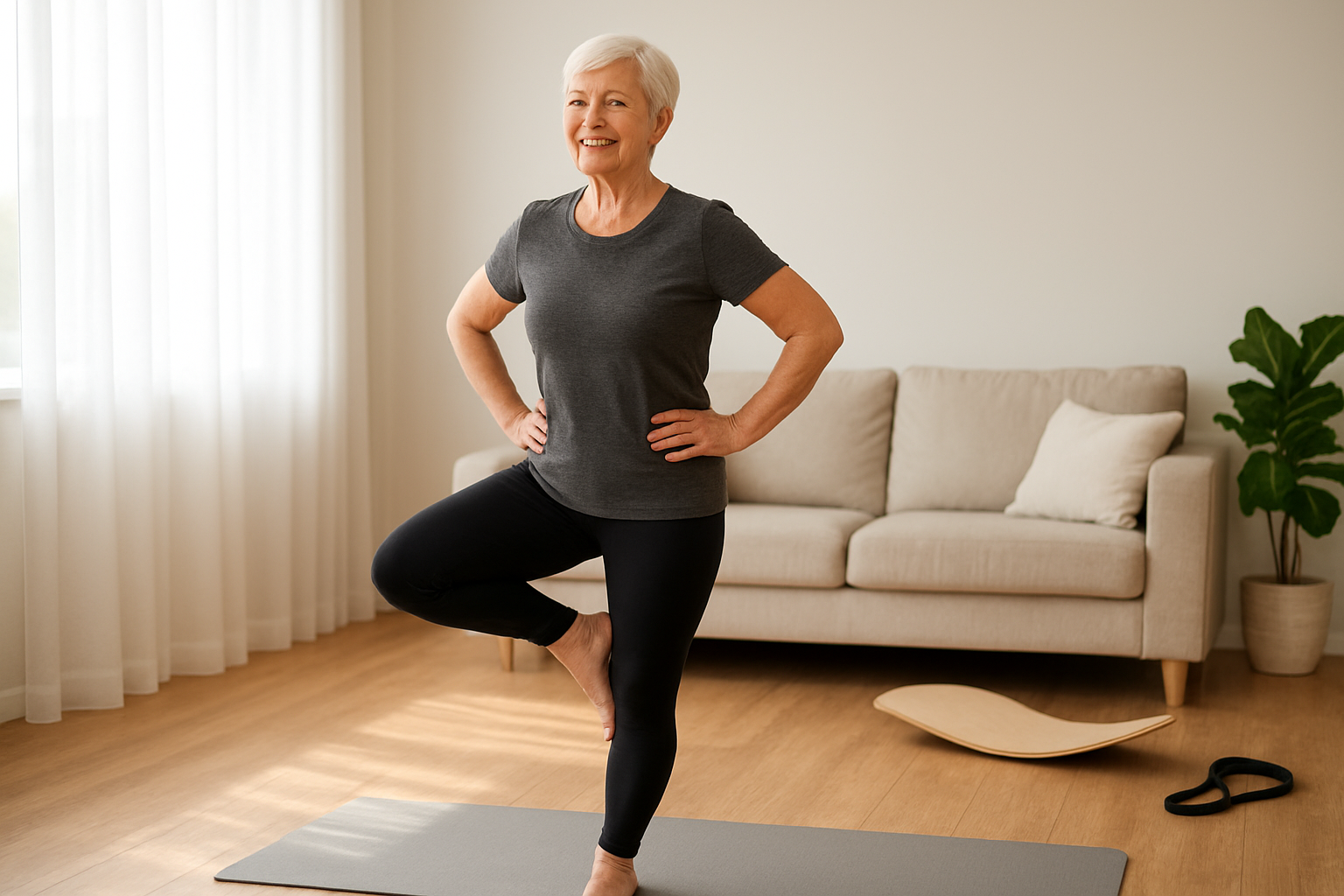
The single-leg stand is one of the most effective balance exercises for seniors because it directly trains the stabilizing muscles your body uses every time you step, turn, or climb stairs.
Here’s how to do it safely:
- Stand near a wall, sturdy chair, or countertop for support
- Plant both feet hip-width apart and find a fixed point to focus your eyes on
- Slowly lift one foot about 6 inches off the floor, bending your knee slightly
- Hold for 10–30 seconds, then switch sides
- Keep your standing leg slightly soft — never lock your knee
- Aim for 3 sets per leg, once daily
If you wobble, that’s completely normal. Just lightly touch your support surface to reset.
How to Progress the Exercise as You Improve
As your stability builds, small adjustments make this exercise significantly more challenging:
| Progression Level | What to Change |
|---|---|
| Beginner | Eyes open, hand on chair |
| Intermediate | Arms crossed over chest, no support |
| Advanced | Eyes closed for 10–15 seconds |
| Challenge | Stand on a folded towel or cushion |
Closing your eyes removes visual input, forcing your muscles and inner ear to do the real balancing work — a powerful upgrade for improving balance after 50.
Heel-to-Toe Walk to Strengthen Your Gait
Why This Exercise Mimics Real-World Movement
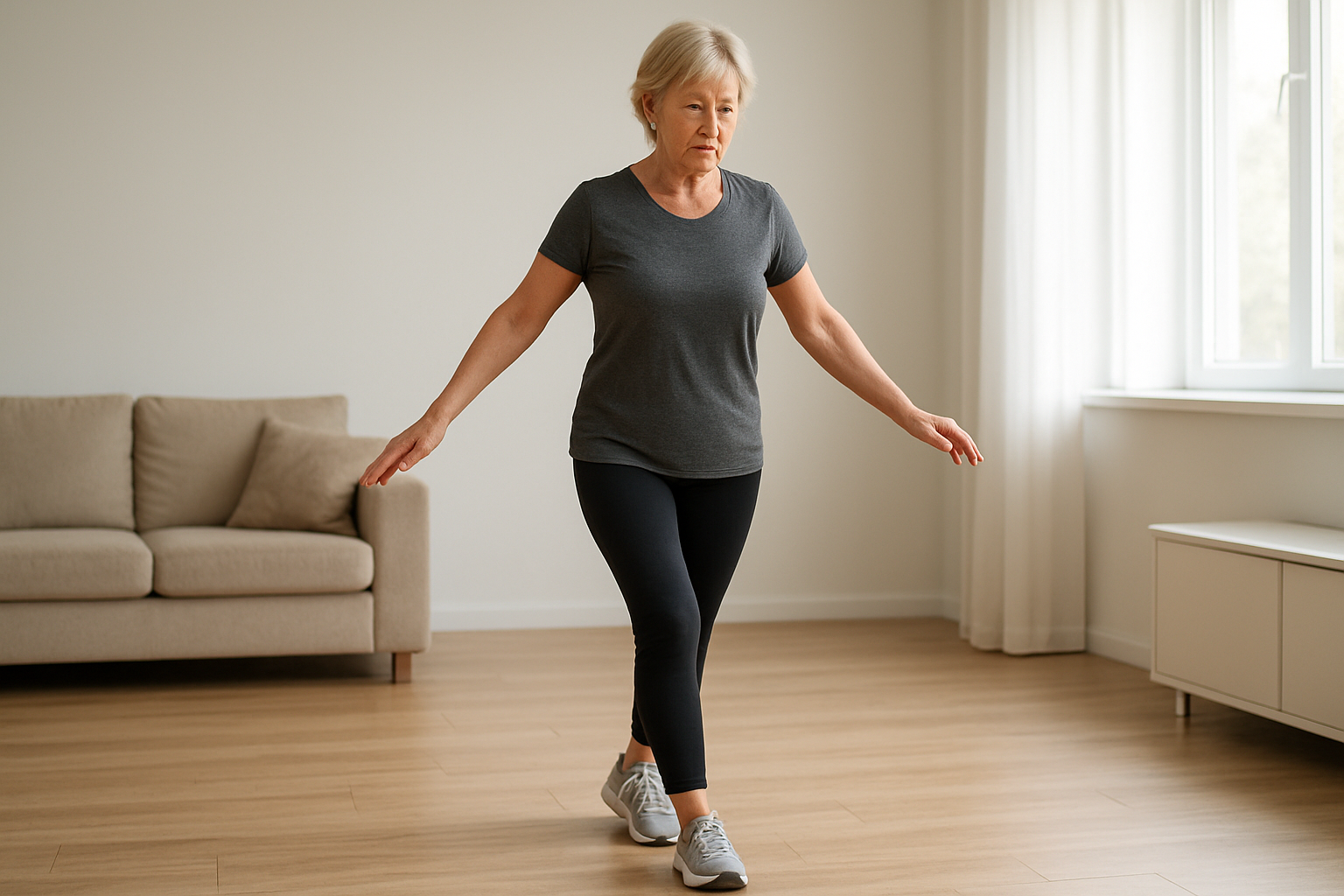
Walking heel-to-toe — like you’re on a tightrope — closely mirrors how your foot naturally strikes the ground with each step. As you age, your stride often shortens and your gait becomes less controlled, which raises your fall risk significantly. This exercise retrains your brain and body to work together, sharpening the coordination needed for everyday movement like navigating stairs or uneven sidewalks. It’s one of the most practical fall prevention exercises over 50 you can do.
How to Do It Correctly and Avoid Common Mistakes
- Stand near a wall or countertop for support
- Place your right heel directly in front of your left toes, touching or nearly touching
- Focus your eyes on a fixed point ahead — this keeps you steady
- Take 20 steps, then turn around and repeat
Common mistakes to avoid:
- Looking down at your feet (throws off your balance)
- Rushing — slow and controlled is the goal
- Skipping the support surface if you feel unsteady
Easy Variations to Match Your Fitness Level
| Level | Modification |
|---|---|
| Beginner | Walk alongside a wall, lightly touching it |
| Intermediate | Arms crossed over chest |
| Advanced | Eyes closed for 5–10 steps |
Tai Chi Movements to Improve Balance and Coordination
Why Tai Chi Is Proven to Reduce Fall Risk
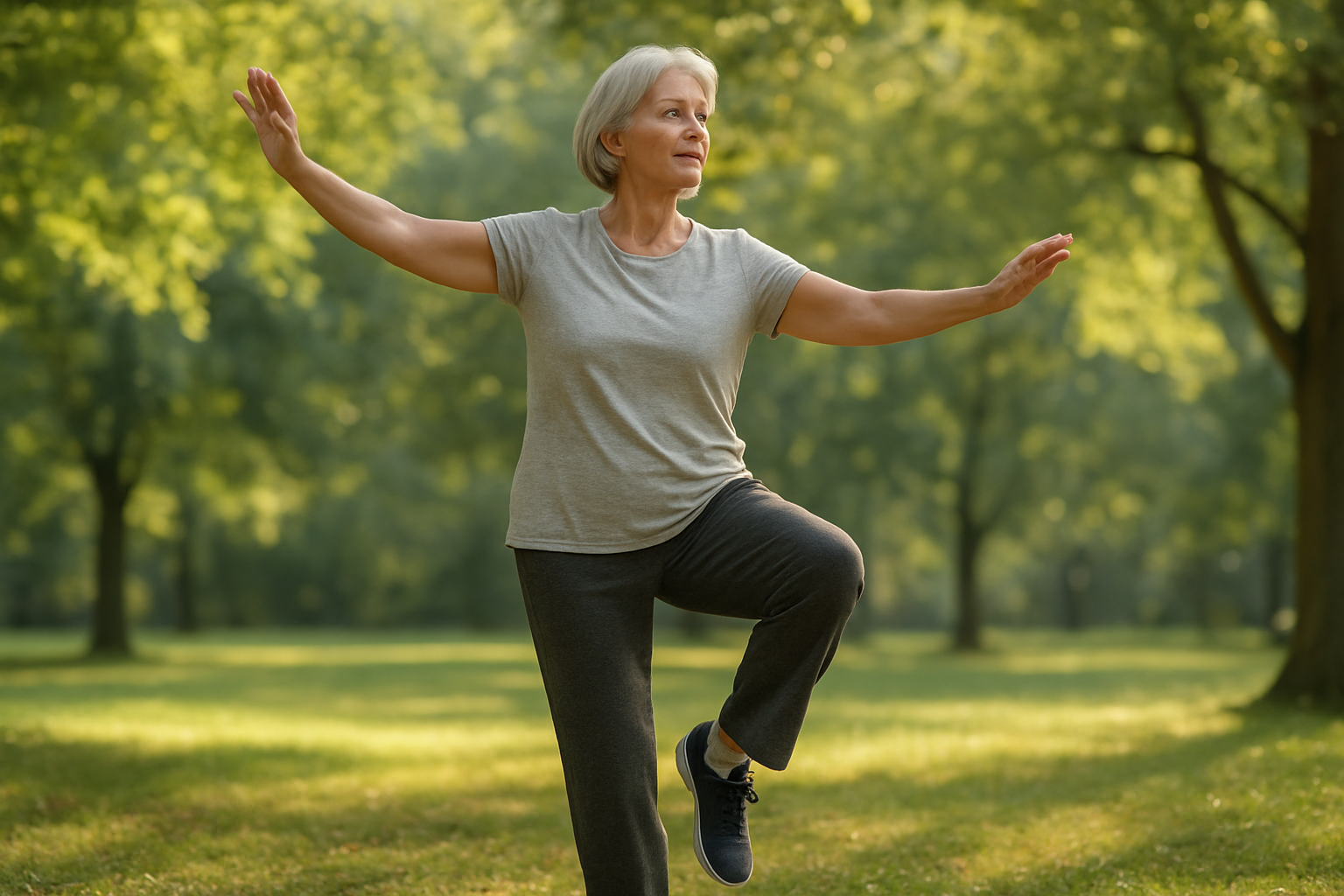
Tai chi for balance and stability isn’t just ancient wisdom — the research backs it up. Studies show tai chi can reduce fall risk in older adults by up to 45%. It works by training your body and brain to communicate better, sharpening proprioception (your body’s sense of where it is in space), and building the slow, controlled strength that actually keeps you upright in real life.
Three Beginner-Friendly Tai Chi Moves to Start With
- Weight Shifting: Stand with feet shoulder-width apart. Slowly transfer your weight from one foot to the other, like a gentle rocking motion. Hold each side for 3–5 seconds.
- Single Whip: Step one foot out to the side while extending one arm, keeping your gaze forward. This trains lateral stability.
- Cloud Hands: Move your arms in slow, overlapping circles while shifting weight side to side. It builds coordination and core control together.
How to Find a Class or Follow Along at Home
| Option | Best For |
|---|---|
| Local community centers | Social motivation, live feedback |
| YouTube (search “tai chi for seniors”) | Free, flexible, at-home practice |
| Silver Sneakers app | Structured senior-focused programs |
Aim for 2–3 sessions weekly to see real improvement in balance and coordination.
Side Leg Raises to Strengthen Your Hips and Core
How Strong Hips Protect You From Falls
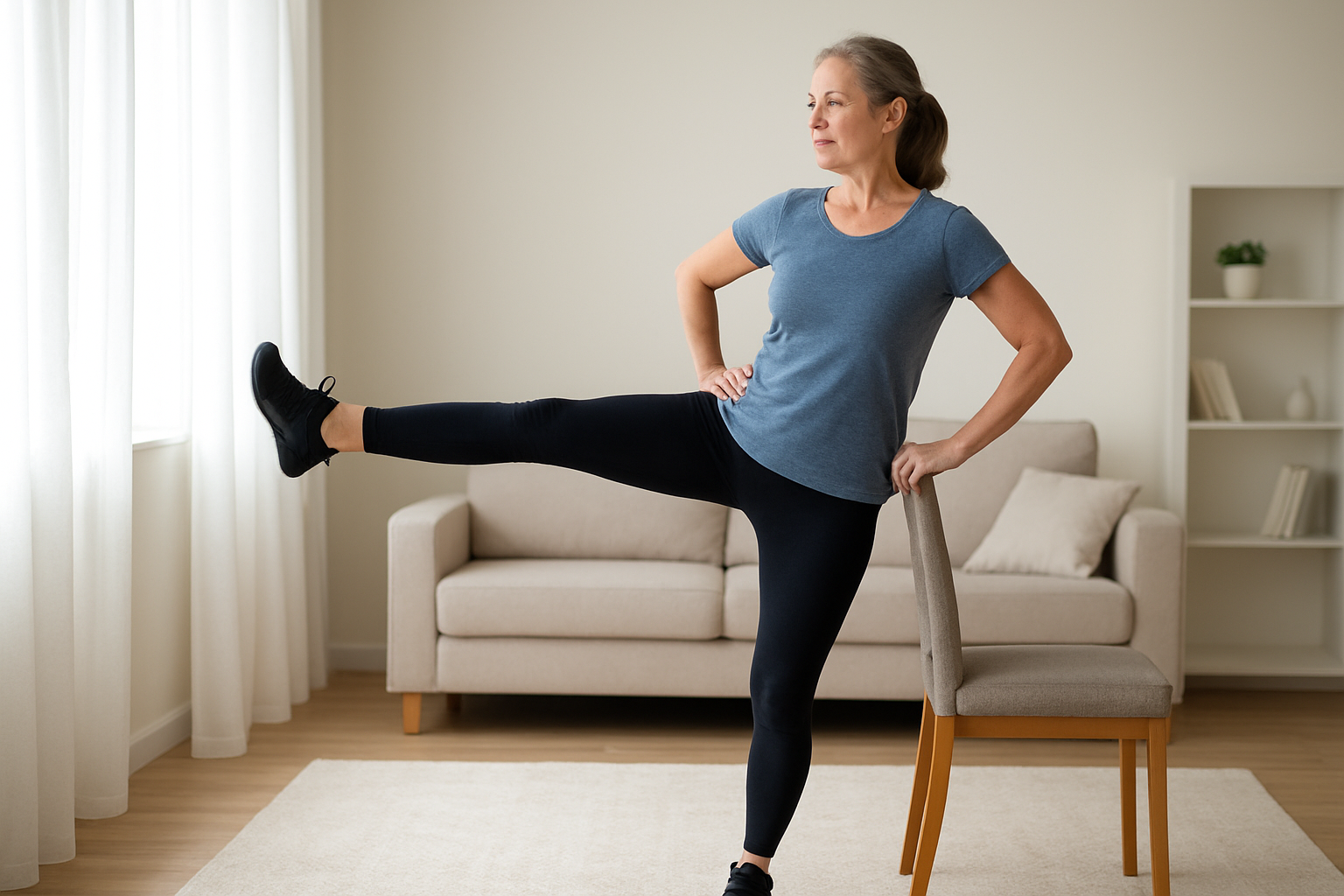
Weak hips are one of the biggest reasons people over 50 lose their balance. Your hip abductors act like a built-in stabilizer every time you take a step, shift your weight, or recover from a stumble. Stronger hips mean faster, more automatic corrections before a fall ever happens.
Proper Form to Maximize Results and Prevent Strain
- Stand behind a chair, holding the back lightly for support
- Keep your back straight and core gently engaged
- Lift one leg directly out to the side — no higher than 12 inches
- Hold for 2 seconds, then slowly lower it back down
- Complete 10–12 reps per side
Move slowly and deliberately. Fast, sloppy reps won’t build the stability you’re after.
How to Add Resistance as You Get Stronger
| Stage | Method |
|---|---|
| Beginner | Bodyweight only |
| Intermediate | Light ankle weights (1–2 lbs) |
| Advanced | Resistance band just above knees |
Increase resistance only after you can complete 15 clean reps without losing form.
Seated Modifications for Limited Mobility
Sit tall in a firm chair with feet flat on the floor. Lift one leg out to the side as far as comfortable, hold briefly, then lower. This keeps the movement effective while reducing joint stress — a solid entry point for lower body strength exercises for older adults.
Calf Raises to Improve Lower Body Power
Why Strong Calves Are Essential for Balance
Your calves do far more than most people realize. Every time you take a step, climb stairs, or recover from a stumble, your calf muscles are working hard to keep you upright. Weak calves are directly linked to a slower “righting response” — that split-second reaction your body needs to catch itself before a fall happens.
For adults over 50, calf strength tends to decline faster than other muscle groups, quietly increasing fall risk without obvious warning signs. Building this strength back up is one of the smartest lower body strength exercises for older adults you can add to your routine.
How to Perform Calf Raises Safely at Home
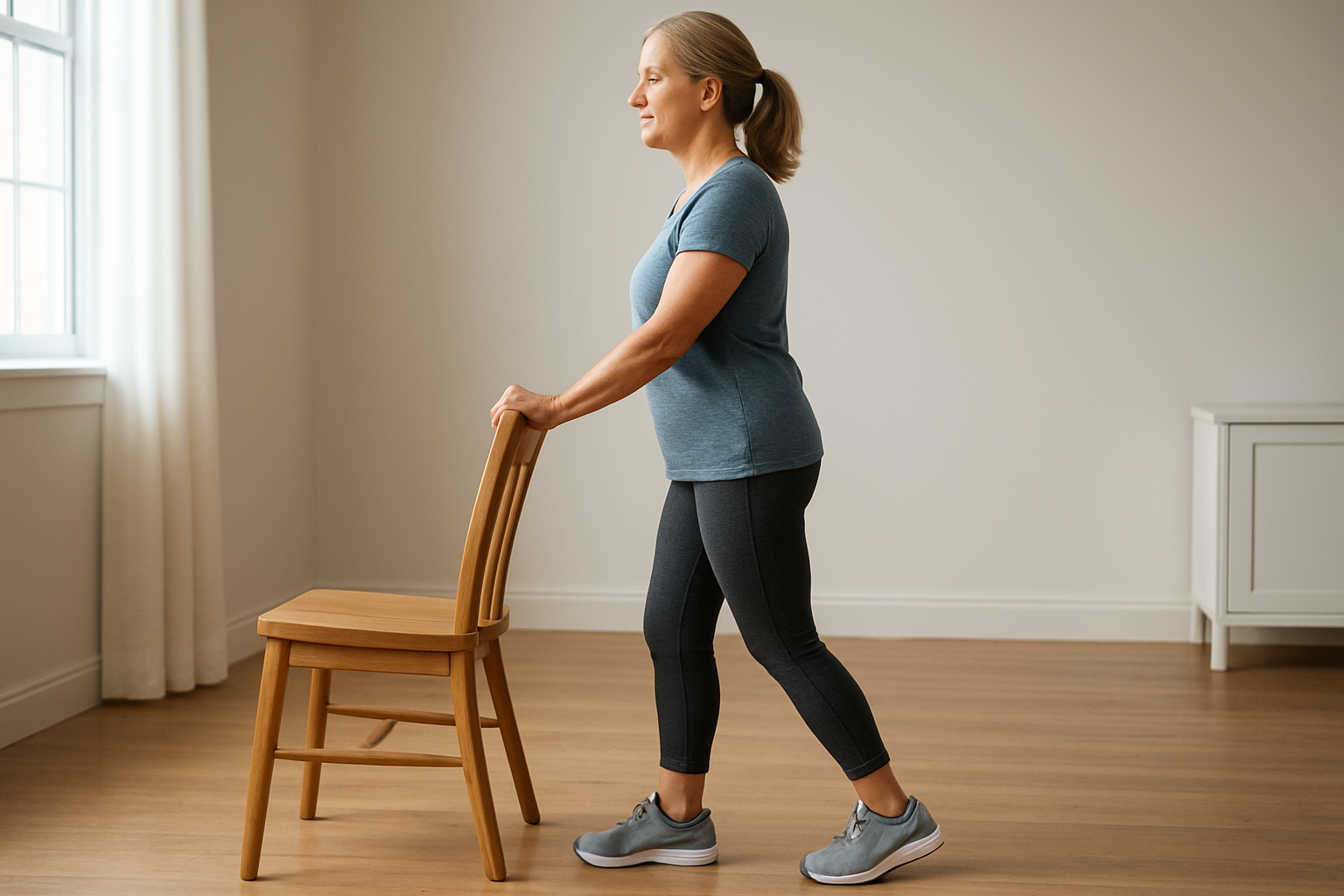
What you need: A sturdy chair or countertop for support.
Steps:
- Stand behind a chair, lightly resting both hands on the back
- Slowly rise onto the balls of both feet
- Hold at the top for 2–3 seconds
- Lower back down with control — don’t drop quickly
- Repeat 10–15 times for 2–3 sets
Safety tips:
- Keep movements slow and controlled
- Avoid locking your knees at the top
- Progress to single-leg calf raises as strength builds
Sit-to-Stand Exercise to Boost Everyday Confidence
How This Move Translates Directly to Daily Activities
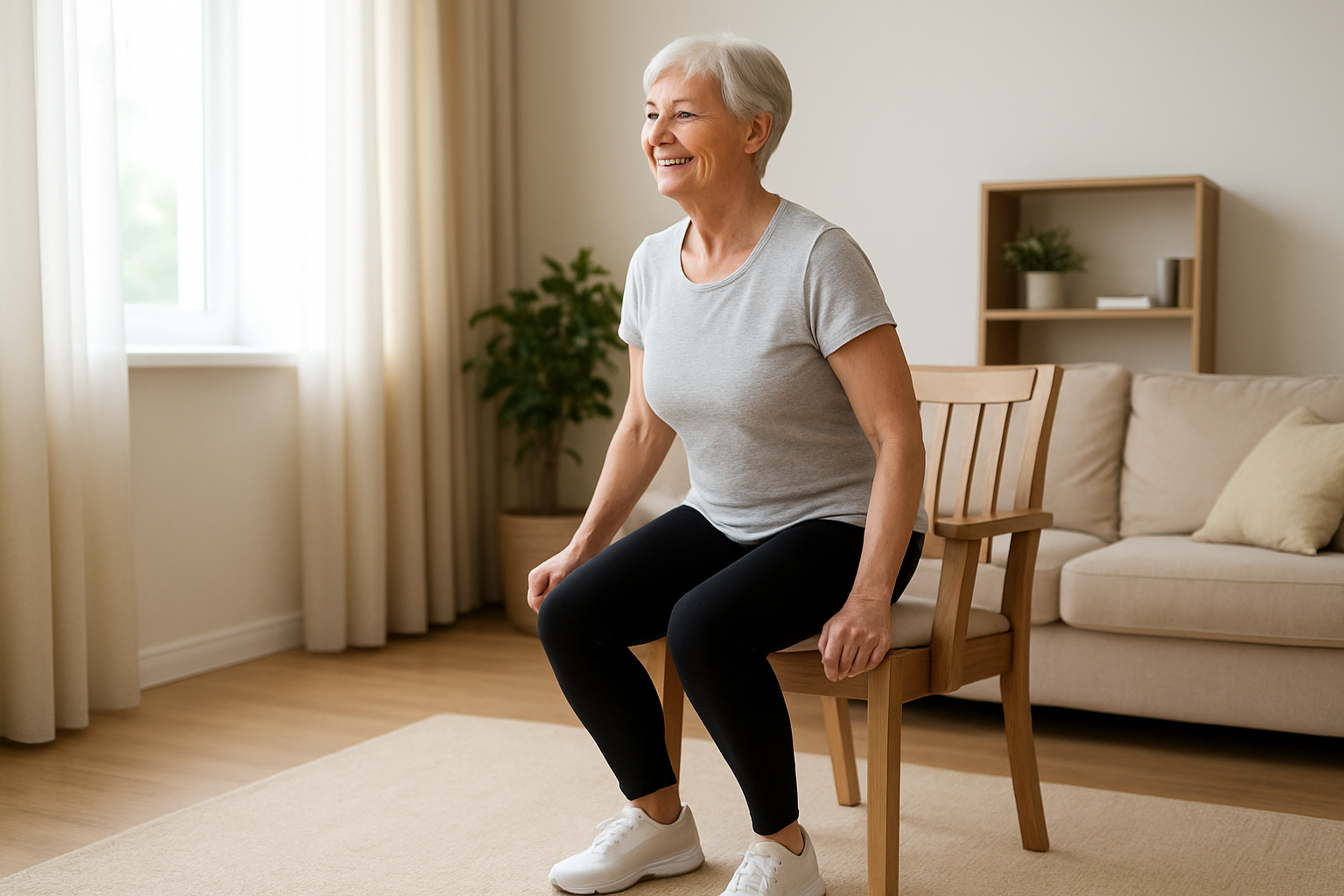
Getting up from a chair is something you do dozens of times daily — from the couch, toilet, car seat, and dining table. When that movement becomes difficult or shaky, it quietly signals declining lower body strength and balance. The sit-to-stand exercise directly trains this pattern, building the muscle memory and leg strength you need for real independence.
Key Form Tips to Protect Your Knees and Back
- Sit near the front edge of your chair with feet shoulder-width apart
- Keep your chest tall and lean slightly forward from the hips — not the waist
- Push through your heels, not your toes, as you rise
- Avoid using your hands to push off (once you’re able)
- Lower back down slowly and with control — don’t just drop
Start with a firm chair. Skip cushioned or rocking chairs until your strength improves.
How to Track Your Improvement Over Time
Use the 30-Second Chair Stand Test — count how many times you can stand and sit within 30 seconds.
| Age Group | Average Reps (Women) | Average Reps (Men) |
|---|---|---|
| 60–64 | 12–17 | 14–19 |
| 65–69 | 11–16 | 12–18 |
| 70–74 | 10–15 | 12–17 |
Retest every 4 weeks to watch your progress climb.
Balance Board Training to Challenge Your Stability
What a Balance Board Is and Who Should Use It
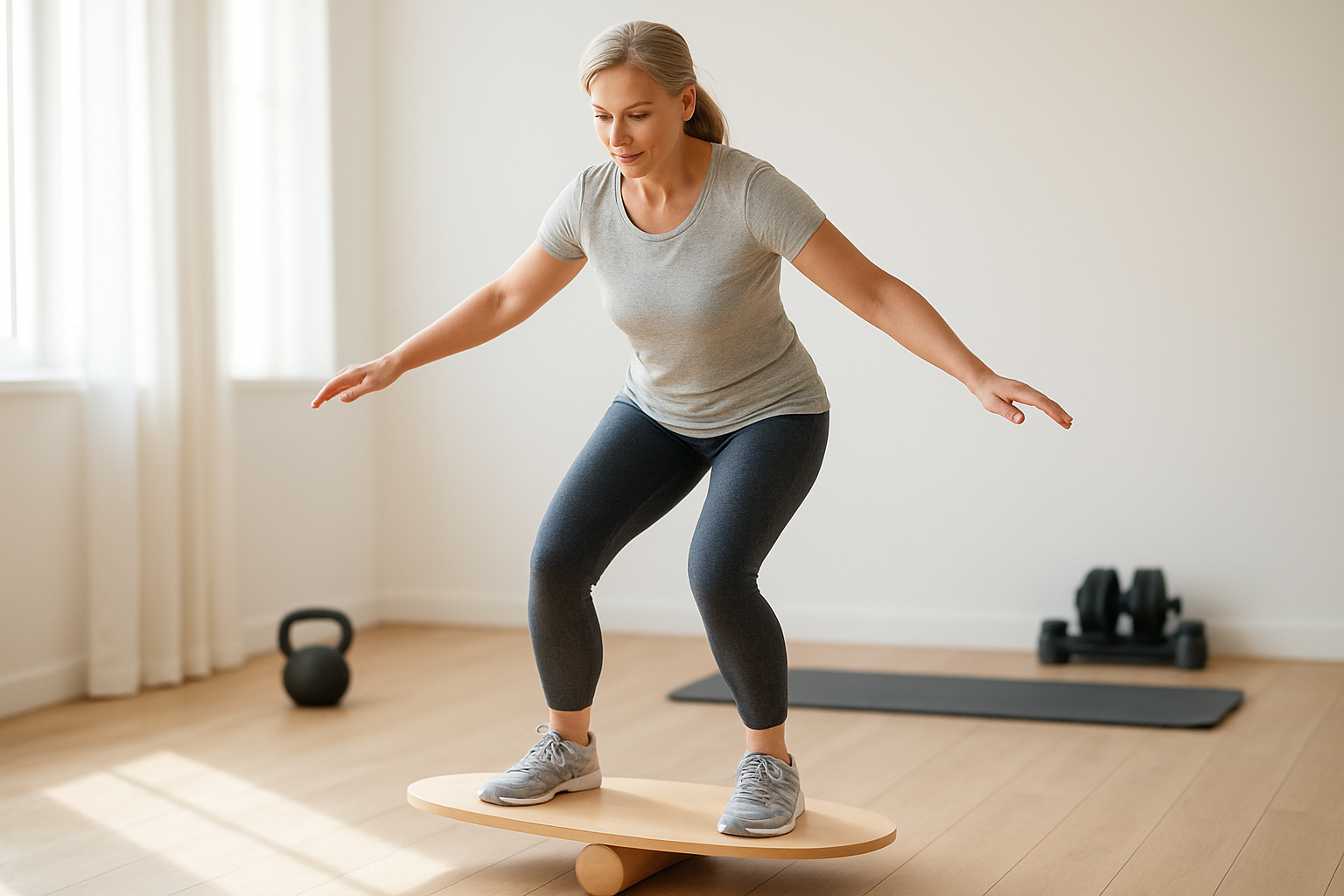
A balance board is a flat platform set on a curved or roller base that wobbles as you stand on it. That instability forces your ankles, knees, and core to fire constantly — making it one of the most effective balance board exercises for seniors looking to sharpen stability fast.
Best suited for adults who can already stand on one leg for 10+ seconds without holding on. If you’re still building basic strength, finish the earlier exercises first.
Beginner Exercises to Safely Build Board Confidence
- Stand on the board with both feet, holding a chair or wall nearby
- Shift your weight slowly side to side for 30 seconds
- Progress to small forward-and-back rocking once you feel steady
- Try standing still for 60 seconds with minimal wobble
How to Choose the Right Board for Your Needs
| Board Type | Best For |
|---|---|
| Rocker board | Beginners, side-to-side motion |
| Wobble board | Intermediate, multi-directional |
| Roller board | Advanced, full instability challenge |
Signs You Are Ready to Advance Your Training
- You can stand wobble-free for 60 seconds
- You feel no ankle soreness after sessions
- You can close your eyes briefly without grabbing support
Staying steady on your feet after 50 is something you have real control over, and these seven exercises prove it. From the simple single-leg stand to balance board training, each movement works together to strengthen your hips, core, and lower body while sharpening the coordination your body needs to stay upright in everyday life. Small, consistent effort adds up fast.
The best part? You don’t need a gym or fancy equipment to get started. Pick two or three exercises from this list and work them into your daily routine a few times a week. Give it a few weeks, and you’ll likely notice you’re moving with more confidence, whether you’re walking on uneven ground, stepping off a curb, or just getting up from a chair. Your balance is worth protecting — start today.